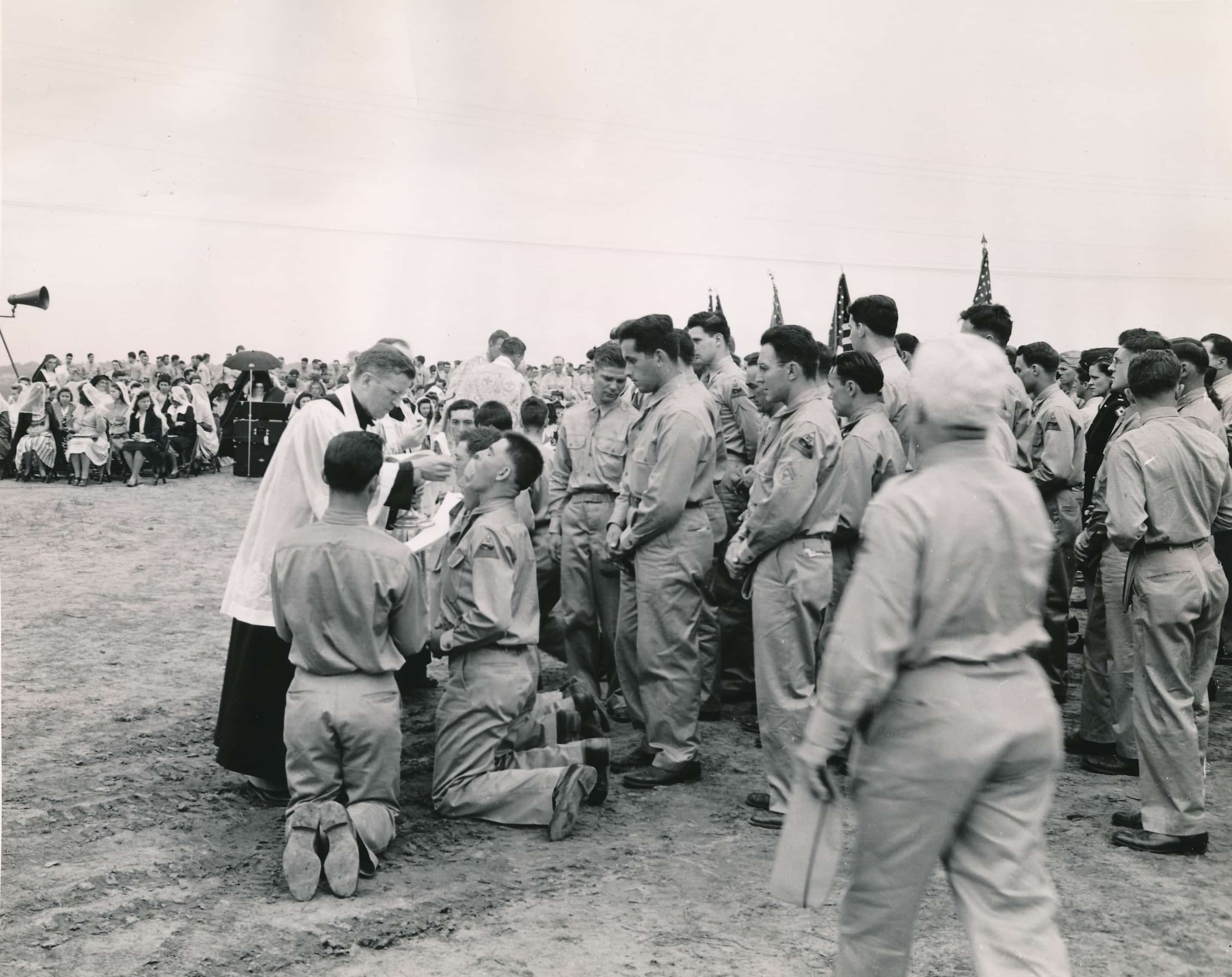
Soldiers reverently kneel to receive the Eucharist at a Pontifical Field Mass celebrated by Bishop Francis R. Cotton on Mother’s Day, Sunday, May 9, 1943, in Camp Campbell, Ky. COURTESY OF ARCHIVES
The battle for souls: The Diocese of Owensboro’s military chaplains
BY EDWARD WILSON, ARCHIVES
It’s early 1945, and the United States digs in their heels for a war they fear may last another decade. Fr. Henry Pius O’Bryan, a “young… robust” priest, with “solid… morals and piety” makes a request to his bishop, Bishop Francis R. Cotton, the first bishop of the Diocese of Owensboro, to serve his country as a chaplain. Bishop Cotton proudly writes a letter of recommendation, heaping praise on the young priest, claiming, “Father should make you a very good chaplain in the navy.”
In November, the United States gives special acknowledgement to those brave men and women who serve in our military, particularly through the observance of Veterans Day on Nov. 11. This made me think about how much the archive has been dealing with chaplain records recently.
This year alone, we have received the military documents of multiple priests who served as chaplains; transferred military documents to the Archdiocese for the Military Services, U.S.A.; accessioned the documents for our newest priest who was also co-sponsored by the military archdiocese, Fr. Conrad Jaconette; and, most recently, assisted a member of the diocese who was looking for the burial place of a chaplain, Fr. Donald Hunter.
Perhaps our earliest diocesan priest to serve was Fr. Albert J. Thompson, later Msgr. Thompson. Fr. Thompson served as a chaplain in France in 1918 during the First World War, nearly two decades before the diocese was even established. For more information, I previously wrote an article on his WWI Mass kit and military identification card that are preserved in the Mount Saint Joseph archives, in the September 2020 issue of The Western Kentucky Catholic.
Our first two bishops were quite active in their priestly duties for the military as well. Bishop Cotton was happy to offer Mass at Camp Breckenridge and Camp Campbell. Stating it was “because of the obligation,” he felt “we all have to supply our armed forces…” Likewise, writing a letter of recommendation for a young chaplain, Bishop Henry J. Soenneker recalled, “I am old enough to remember the First World War. I served as Auxiliary Chaplain in World War II.”
Finally, Fr. Donald Hunter was a diocesan priest, who perhaps more than any other, seemed to have been born for the position of chaplain. A bit more than a year after the Gulf of Tonkin incident, which increased U.S. involvement in Vietnam, Fr. Hunter was assigned to serve the Air Force in 1966. He served at Johnston Atoll, was stationed several places in the U.S., and did a two-year tour in Germany. He started his service with a three-year commitment but was later selected for regular commission. He served until tragically passing in 1980 at the age of 45, at Chanute Air Force Base in Illinois. Chaplain, Captain, Fr. Hunter was later honored by the base with the dedication of one of their buildings as Hunter Hall on Sept. 12, 1980. Bishop Soenekker, along with many others, attended the ceremony.
As you can see, this is much too short and not an exhaustive list of those who served as chaplains in our diocese’s history. Many of these stories will likely receive their own articles in the future. Thank you to all who serve, and St. Michael the Archangel defend them in battle!
Edward Wilson is the director of the Diocese of Owensboro’s Archives and the Archives of the Ursuline Sisters of Mount Saint Joseph. Comments and questions may be sent to [email protected].
Originally printed in the November 2025 issue of The Western Kentucky Catholic.