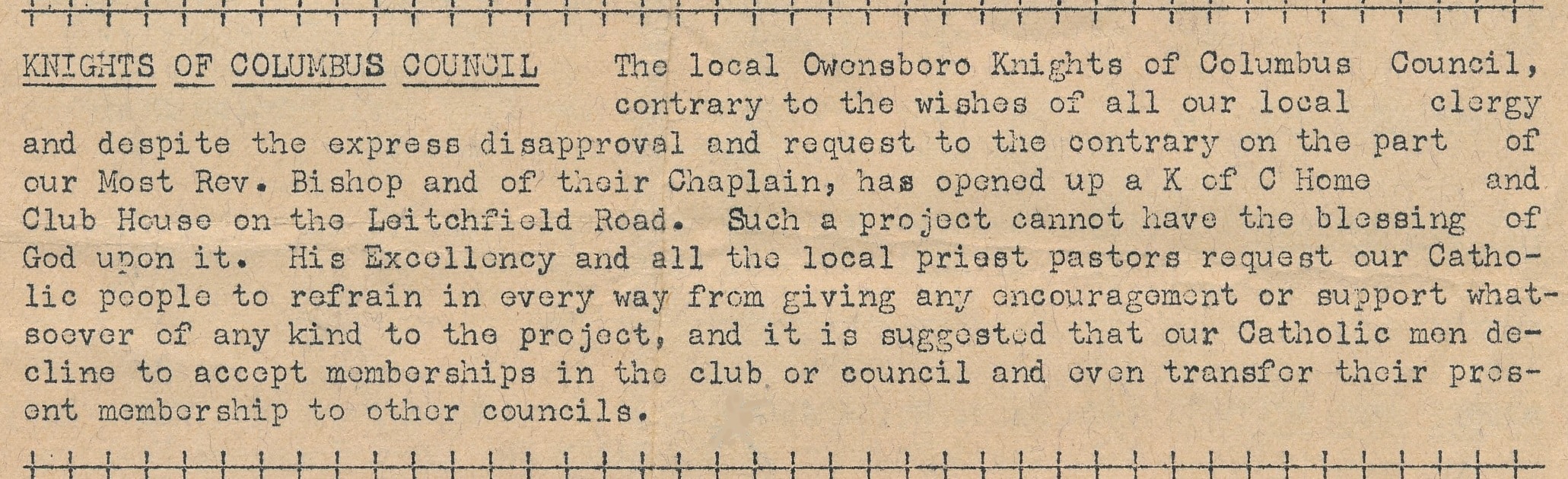
An excerpt is shown from St. Stephen Cathedral’s bulletin on June 27,1954, detailing Bishop Francis R. Cotton’s directive regarding the local Knights of Columbus council. COURTESY OF ARCHIVES
‘Playing with dynamite’ – Bishop Cotton vs. the Knights of Columbus
BY EDWARD WILSON, ARCHIVES
In the early 1950s, a Knights of Columbus council in Owensboro wanted to build a clubhouse for the recreation of its members.
When the request was introduced to Bishop Francis R. Cotton, he flatly denied it. Though this may seem like an arbitrary authoritarian move by our first bishop, he had good reason. Some bad actors had recently been conducting unsanctioned gambling within the group. No doubt, a clubhouse would have exacerbated this problem.
Over the next several months, a dramatic saga ensued.
Though they believed the issue was settled, this was not the case. On Dec. 1, 1953, Msgr. William Jarboe, the council’s chaplain, wrote Bishop Cotton updating him on the situation.
He told the bishop that council meetings had repeatedly been cancelled for months. However, he had recently been made aware that secret meetings had been occurring at Gabe’s Steakhouse. The purpose of the meetings was to make progress on the clubhouse.
Msgr. Jarboe let the council know the bishop would not stand idly by and informed them that they were “playing with dynamite.” Disregarding this warning, the council bought land and tore down the existing structure with the intent of building the clubhouse. Even through this the bishop remained quite silent.
However, after the Messenger-Inquirer printed an announcement about the clubhouse and praised the recreation it would offer, the bishop’s patience with the council ran out.
Bishop Cotton was invited to the regional gathering for the K of C. When he did not show, he received several letters from various K of C national leaders saying they wished he could have made it and hoped there were no hard feelings over the clubhouse business. Bishop Cotton cooly replied that he had no hard feelings against the K of C, who did great, godly work; however, he would direct any member of the Owensboro diocese against joining the Owensboro council. If they wished to join, they could do so with the next nearest council. He would likewise advise current members to do the same. The K of C leaders were dumbfounded. They understood such a declaration would be a death knell for the council. St. Stephen’s bulletin published the bishop’s directive on June 27,1954.
State K of C leaders wrote the council telling them to obey the bishop going forward without question. Further, they ordered the council to sell the property and take the loss.
The excerpt in the old St. Stephen’s bulletin was brought to my attention by parishioner Eddy McFarland. He asked if I had any information on what had caused the bishop’s condemnation of the council. Intrigued, I decided to look into the matter further. The bulletin alone makes the situation appear to be a strange campaign of the bishop launched against the Knights.
In actuality, it turned out to be a very necessary action. A skilled statesman, Bishop Cotton worked behind the scenes trying to come to terms amicably. When the council flagrantly defied his decision, the bishop dropped the hammer and immediately enacted his authority as the leader of the souls in his diocese.
This is a good historical example of how one single item taken alone and out of context can paint a fatally flawed account of a situation. If you endeavor to let it, the past will often speak for itself.
Edward Wilson is the director of the Diocese of Owensboro’s Archives and the Archives of the Ursuline Sisters of Mount Saint Joseph. Comments and questions may be sent to [email protected].

An undated photo shows Msgr. William Jarboe, the chaplain of St. Stephen Cathedral’s then-Knights of Columbus council. COURTESY OF ARCHIVES
Originally printed in the February 2026 issue of The Western Kentucky Catholic.