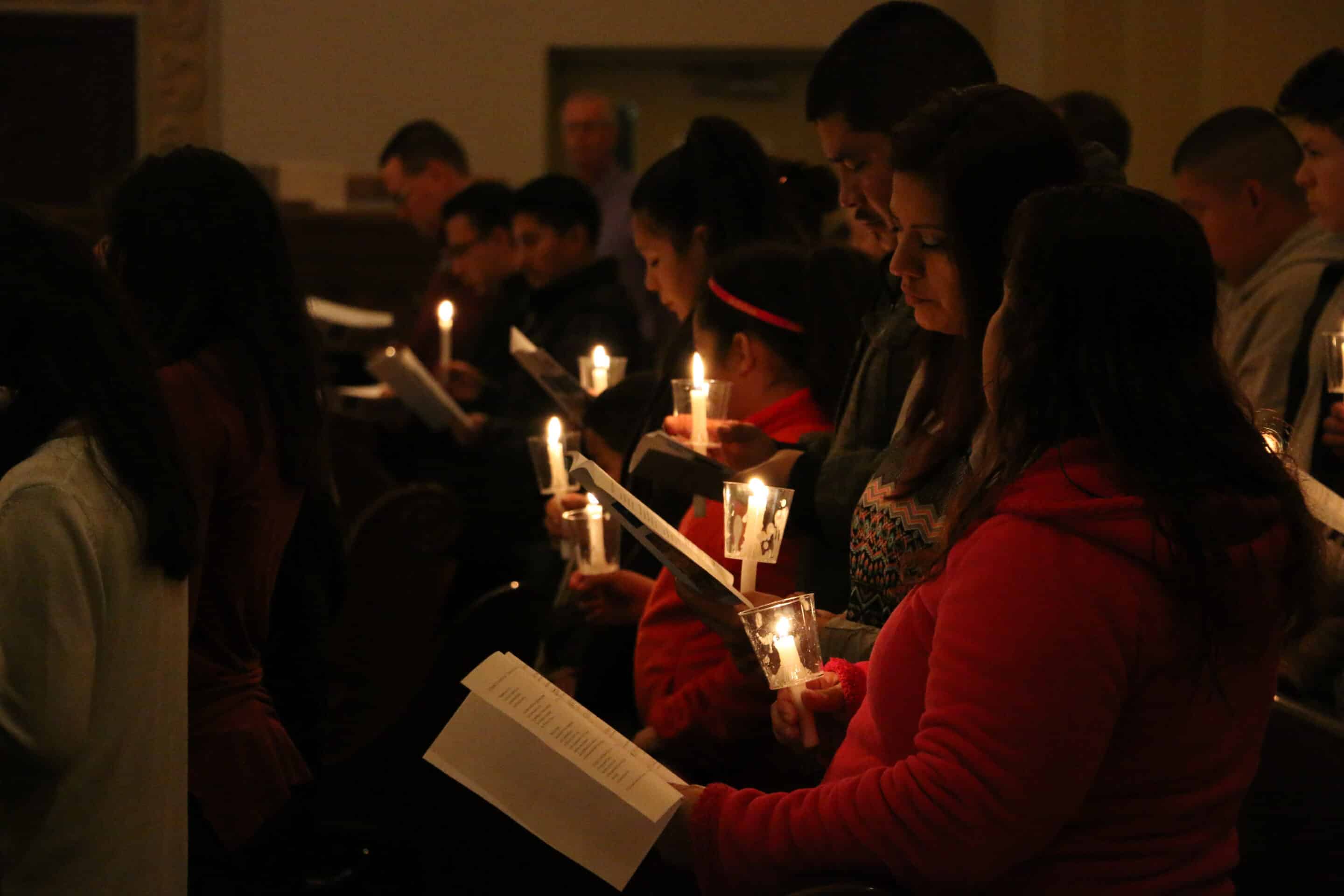
On Jan. 3, 2017, members of the faithful hold candles while participating in a prayer service at St. Stephen Cathedral for the needs of immigrants and refugees. FILE PHOTO
This Lent, let us work to dispel all forms of racism from our hearts
Dear Sisters and Brothers in Christ,
The United States Conference of Catholic Bishops in 2018 published a pastoral letter addressed to our nation entitled: Open Wide Our Hearts: The Enduring Call to Love – A Pastoral Letter Against Racism. I am very proud to have been a member of the committee that proposed this letter to the conference.
With the publication of this letter the bishops stated, “We want to address one particularly destructive and persistent form of evil. Despite many promising strides made in our country, racism still infects our nation.”
It has been nearly eight years since the letter’s publication, and more recent years have demonstrated unfortunate incidents and attitudes that seem to indicate that our nation is moving in the wrong direction in addressing this particular intrinsic evil.
One example is found when we look at the tragic implementation of policies and actions seeking to address the complexities of immigration and border security. These concerns about our broken immigration system are legitimate and for decades there has been bipartisan support for commonsense solutions that protect our nation while also acknowledging the God-given human dignity of immigrants and refugees. Instead of proactive reform, however, we find ourselves witnessing the abuse of millions of people, most of whom have lived peaceably in our country for years or even decades and have been productive contributors to our nation’s well-being.
We might also look at what to me seems to be a broadening tolerance of racism. In my lifetime I observed the emergence of the Civil Rights Movement. This movement, overwhelmingly by peaceful means, has contributed to passage of historic legislation affirming civil rights and voting rights for all citizens, more than one hundred years after the Civil War.
As this movement unfolded I found myself at times in need of conversion, recognizing that I had grown up in a culture all too accepting of prejudice and racism. And, sadly, growing up in my beloved Catholic Church, I realized that it too had often shared in such deep prejudices, shared in racism.
The bishops’ 2018 pastoral letter presents a perspective on racism: “Racism arises when – either consciously or unconsciously – a person holds that his or her own race or ethnicity is superior, and therefore judges persons of other races or ethnicities as inferior and unworthy of equal regard. When this conviction or attitude leads individuals or groups to exclude, ridicule, mistreat, or unjustly discriminate against persons on the basis of their race or ethnicity, it is sinful.”
The bishops’ letter goes on to state that racist acts are sinful because they violate justice.
I have prayerfully considered my responsibilities as a shepherd of the Church to address racism in this time and place. I am stirred to speak now after the White House recently posted a social media meme portraying one of our past presidents and first lady, who are African American, as apes. This is flagrantly and objectively racist.
Perhaps those of us who follow social media in any way can easily become accustomed to distasteful and even racist messages. When such a despicable post comes from the office of our nation’s president, it furthers the notion that this sin of racism may be tolerated, even if we as individuals know we would never promote such ugliness.
The White House subsequently attributed this media posting to an unidentified staffer. The White House stated emphatically, though, that no apology would be issued nor was an apology necessary.
The White House and the Office of the President of the United States represent all Americans to the world. In a vast organization such as the White House, rogue actors can create chaos. Chaos can and should be rectified and humility dictates that when a mistake has been made it is corrected in charity. When the message is that such blatant racism merits no apology, I fear those who manifest these actions are further emboldened to defend their own sinful attitudes and behaviors.
Racism lives within every person, perhaps not far below the surface of our character. It has been fed by original sin and thousands of years of bigotry and exploitation. As Catholics, as moral people of good will, we are called to address this inclination to sin as we do disregard for human dignity, idolatry, greed, lust, and any other sin.
During this holy season of Lent, I call upon all people to engage in personal conversions of heart to dispel racism from our hearts and our society and our culture.
We do this by praying for guidance and wisdom from the Holy Spirit.
We do this by a personal examination of conscience, acknowledging attitudes or actions that have demeaned others based upon race or ethnicity.
We do this by committing ourselves to dispel even from our private thoughts that which is destructive or harmful to others.
A genuine examination of conscience is never easy. But it is all the more challenging when we must examine our very character.
May God bless you all,

Most Reverend William F. Medley
Diocese of Owensboro
Originally printed in the March 2026 issue of The Western Kentucky Catholic.